

New Delhi: In a milestone moment for global trade diplomacy, India and the European Union on Tuesday announced the successful conclusion of negotiations on a comprehensive Free Trade Agreement (FTA), described by officials on both sides as the “Mother of All Deals.”
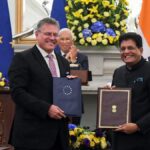
The pact — finalised during high-level talks in New Delhi with Prime Minister Narendra Modi, European Commission President Ursula von der Leyen and European Council President António Costa present — marks a defining shift in economic and strategic cooperation between the world’s largest democracy and one of the largest economic blocs.
The modern, rules-based agreement is designed to unlock a combined market with a GDP of around USD 24 trillion and encompass nearly two billion consumers, reinforcing economic resilience amid a volatile global landscape.
Under the pact, India secures preferential access on 97% of EU tariff lines, covering 99.5% of its export value, with immediate duty elimination on over 70% of tariff lines — a major boon for labour-intensive sectors such as textiles, apparel, leather, footwear, marine products, gems and jewellery, tea, coffee and spices.
The tariff liberalisation is expected to enhance competitiveness of Indian exports in the EU market and strengthen integration into European value chains.
In return, India has offered market access on over 92% of its tariff lines, covering 97.5% of EU exports — including phased duty reductions on high-technology and capital goods — which is projected to diversify import sources, lower input costs for Indian industry and catalyse domestic manufacturing under initiatives such as Make in India.
Beyond Tariffs: Services, Mobility & Regulation
The agreement extends far beyond traditional tariff cuts. It embeds deep commitments on services — with the EU offering liberalisation in 144 services sub-sectors, including IT/ITeS, professional services, education and digital trade, while India has opened markets in selected areas aligned with competitiveness objectives. A structured mobility framework will allow temporary entry for intra-corporate transferees, contractual service suppliers and independent professionals, boosting talent flows and business engagement across both markets.
Regulatory cooperation on sanitary and phytosanitary (SPS) measures, technical barriers to trade (TBT), digital trade and customs procedures is expected to reduce non-tariff barriers, streamline cross-border commerce and enhance predictability for investors and traders alike.
Strategic Implications & Future Outlook
Prime Minister Modi described the deal as a “new blueprint for common prosperity” that not only anchors India’s global trade integration but also reinforces political trust and shared ambition with the EU. European leaders underscored the pact’s scale and strategic importance, framing it as a timely response to rising protectionism and supply-chain realignments in the global economy.
In addition to trade and services, the summit produced several complementary agreements spanning security, technology cooperation, clean energy initiatives and mobility frameworks, signalling a broad elevation of India–EU relations.
The formal signing and ratification of the FTA are expected later in 2026, with implementation anticipated by early 2027, once necessary legal vetting and approvals are completed on both sides.